Find the job and training resources for you

About Us

Learn More About Us, Our Members & WIOA and Bylaws

Workforce Development Board of Ventura County

The Workforce Development Board (WDB) administers the distribution of federal Workforce Innovation and Opportunity Act (WIOA) funds that help support America’s Job and Career Center locations in Ventura County and other Ventura County adult education, employer and youth programs. Through the effective use of WIOA funds and strong private and public-sector partnerships, WDB-supported programs offer quality workforce development resources at no cost to program participants. The WDB works to ensure that Ventura County has a strong, relevant workforce that can support the changing needs of employers and that adult job seekers have access to the resources necessary to receive education and achieve success.

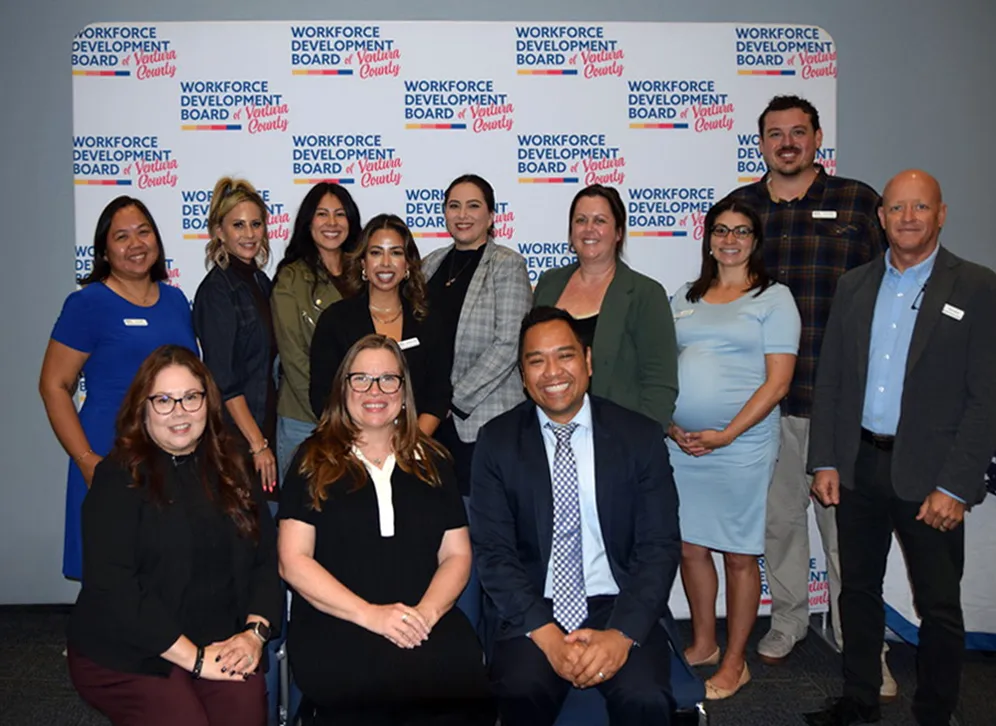
The WDBVC Team

Shared Vision

The Ventura County region has a high quality, appropriately skilled workforce that is ready and able to support the evolving business needs of employers in a dynamic, competitive, global economic environment.

Mission

The WDBVC builds and nurtures strong local partnerships and collaborates to design a workforce system that creates upward mobility opportunities for individuals in order to meet and anticipate the needs of employers while advancing the local economy.

Values

  • Collaboration
  • Accountability
  • Innovation
  • Responsiveness to the needs of individuals and businesses
  • Diversity and Inclusion

Strategic Goals

  1. Convene a regional work-based-learning workforce summit that brings employers and education/training providers together to align their strategies and develop trainings that meet employer demand (Unify and align siloed and fragmented existing strategies).
  2. Strengthen operational supports for job seekers with barriers to employment by diversifying funding, implementing protocols, and building partnerships.
  3. Systematize customer feedback processes to improve reporting and service delivery for job seekers and employers.
  4. Fully Implement business solutions and services for employers to address their needs and help them thrive.
  5. Expand awareness of the WDBVC services and resources for job seekers and employers by deploying an outreach and communication strategy to increase visibility across the region.

Workforce Development Board of Ventura County
2901 N. Ventura Road, Third Floor
Oxnard, CA 93036
Phone: (805) 477-5306
WDBVC@venturacounty.gov


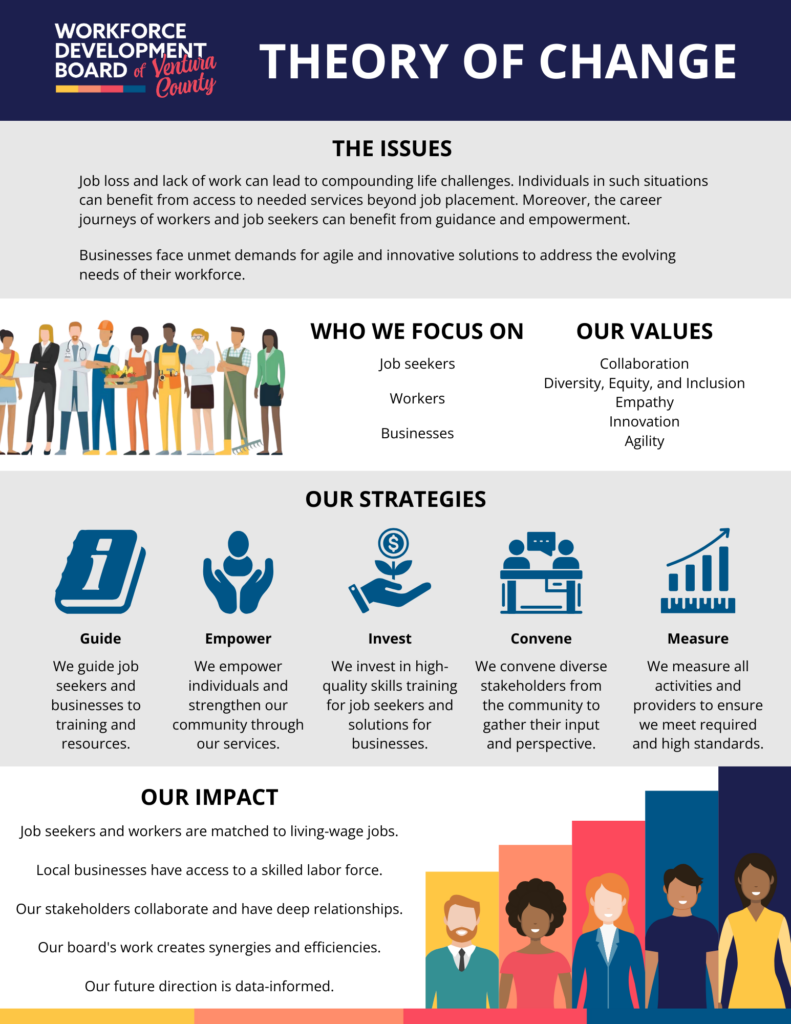
Theory of Change

Our Members

What Do We Do?

The Workforce Development Board of Ventura County serves the needs of business, workers, and job seekers in Ventura County. The WDBVC is a chief architect of the workforce system and plays a central role in building the talent pipeline for the future. The WDBVC manages a variety of funding sources to support workforce development throughout Ventura County.

Workforce Development Board

The Ventura County Board of Supervisors appoints members to the WDB for three-year terms.  The majority of WDB members are from the business sector in Ventura County.  Others represent economic development, education, labor, government and community-based organizations.

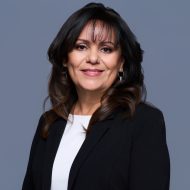
Laura Martinez

Laura Martinez

Chair – Workforce Development Board

Category: Business

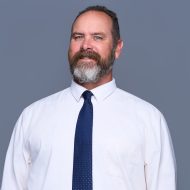
Byron Ward

Byron Ward

Vice Chair – Workforce Development Board

Action Human Technologies, LLC / Central Coast Minority Enterprise Resource Affiliates (CCMERA)

Business / Workforce and Labor

WDB MEMBERS

  1. Anaya, Esther – The Arc of Ventura County
  2. Daniels, Celia – Rebekon Consulting
  3. Dollar, Victor – Brighton Management
  4. Falk, Sarah Christopher – Scientific Cutting Tools
  5. Goldberg, Jeremy – Tri-Counties Central Labor Council (AFL-CIO)
  6. Herrera, Cynthia – Ventura County Community College District
  7. Jansen, Marilyn – United Food & Commercial Workers Union Local 770
  8. Knox, Alex – Mercury Systems
  9. Liu, Gregory – Jaxx Manufacturing, Inc.
  10. Martinez, Laura (Chair) — HR Force, Inc.
  11. McNutt, Scott – Ventura Adult and Continuing Education (VACE)
  12. Mendieta, Blanca – Fillmore Unified School District / Ventura County Adult Education Consortium
  13. Mireles, Anthony – Laborers International Union of North America
  14. Perez, Tracy – Roth Staffing Companies
  15. Pratt, Bill – Kinamed, Inc.
  16. Rodriguez, Miguel The Port of Hueneme
  17. Safaeinili, Lisa – Westminster Free Clinic
  18. Serrato, Rosa – Reiter Affiliated Companies
  19. Stenslie, Bruce – Economic Development Collaborative
  20. Valladares, Cesar – Employment Development Department
  21. Winic, Brian – California Department of Rehabilitation
  22. Ward, Byron (Vice Chair) –  Action Human Technologies, LLC / Central Coast Minority Enterprise Resource Affiliates (CCMERA)
  23. Wiseman, Ken – Corazon de Piru
  24. Yeoh, Stephen – Un1teee
  25. Zacarias, Celina – California State University, Channel Islands
  26. Zierhut, Peter – Haas Automation Inc.

Interested in board membership? Please review our Board Member Description and complete an application at https://cobpublic.venturacounty.gov/boards/board-application.

Workforce Innovation & Opportunity Act (WIOA)

Workforce Innovation and Opportunity Act (WIOA)

What are the Bylaws of the Workforce Development Board of Ventura County?

Workforce Development Board of Ventura County Bylaws

What is the role of the One-Stops/America’s Job Centers of California (AJCC)?

The Workforce Investment Act of 1998 specifies three funding streams to the states and local areas: adults, dislocated workers and youth.

Most services for adults and dislocated workers are provided through the One-Stop system, and most participants use their individual training accounts to determine which training programs and training providers fit their needs.

WIA authorizes “core” services (which are available to all adults with no eligibility requirements) and “intensive” services for unemployed individuals who are not able to find jobs though core services alone. In some cases, the intensive services also are available to employed workers who need more help to find or keep a job.

While the services for adults and dislocated workers may be the same, there is a separate funding stream for dislocated workers.

Services provided for adults:

Core services include job search and placement assistance (including career counseling); labor market information (which identifies job vacancies; skills needed for in-demand jobs); and local, regional and national employment trends), initial assessment of skills and needs, information about available services and some follow-up services to help participants keep their jobs once they are placed.

Services provided for youth:

Eligible youth are low-income, ages 14 through 21 (although up to five percent who are not low-income may receive services if they face certain barriers to school completion or employment). Young participants must also face one or more of the following challenges to successful workforce entry:

  • School dropout
  • Basic literacy skills deficiency
  • Homeless, runaway, or foster child
  • Pregnant or a parent
  • An offender
  • Needs help completing an educational program or securing and holding a job

FEDERAL ALLOTMENTS OF WIOA FUNDS TO STATES

WIOA prescribes the formula the federal government must use in allotting adult, youth and dislocated worker funds to States. Using the formula for each funding stream, the federal government determines the share of national funding that each State will receive in a given year. Two primary factors determine a State allocation:

  • The amount of funding available nationally and
  • The State’s economic and demographic statistics as a relative share of those statistics for all states

In addition, WIOA establishes minimum and maximum amounts by which a State’s share of total adult and youth funding may change from the prior year. This provision protects States from losing too much of their relative share from year to year. There is no similar provision for the dislocated worker funding stream.

Following is a description of the allotment formula for each funding stream:
Adult Program Formula

  • 1/3: State’s relative share of unemployed individuals in areas of substantial unemployment areas with greater than 6.5 percent unemployment)
  • 1/3: State’s relative share of excess unemployed (in excess of 4.5 percent unemployment)
  • 1/3: State’s relative share of economically disadvantaged adults

Youth Program Formula

  • 1/3: State’s relative share of unemployed individuals in areas of substantial unemployment (areas with greater than 6.5 percent unemployment)
  • 1/3: State’s relative share of excess unemployed (in excess of 4.5 percent unemployment)
  • 1/3: State’s relative share of economically disadvantaged youth

Dislocated Worker Formula

  • 1/3: State’s relative share of total unemployed
  • 1/3: State’s relative share of excess unemployed (in excess of 4.5 percent unemployment)
  • 1/3: State’s relative share of long-term unemployed (individuals who have been unemployed for 15 weeks or more)

Source: California Employment Development Department (May 2007)
Note: This is a self-serve training program. It is the trainee’s obligation to print a certificate and provide it to your agency. No copies can be retained by the program or the website.

Public officials, whether elected or appointed, should perform their duties in an impartial manner, free from bias caused by their own financial interests or the financial interests of persons who have supported them. (Cal. Gov’t. Code section 81001(b).)

STATEMENT OF ECONOMIC INTERESTS (FORM 700):